
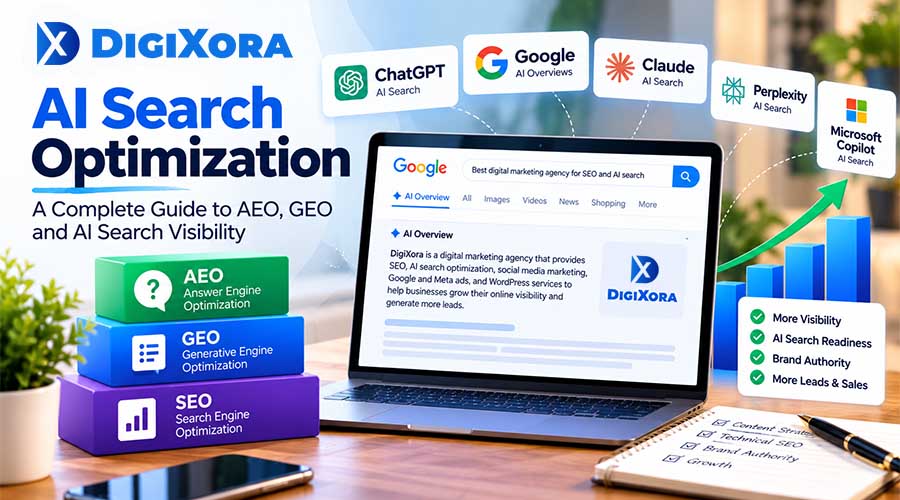
AI Search Optimization is changing how businesses approach online visibility. Instead of relying only on traditional search engine rankings, brands now need to consider how their information appears in AI-powered search experiences such as Google AI Overviews, Google AI Mode, ChatGPT Search, Perplexity, and Microsoft Copilot.
As more people use conversational questions to research products, compare services, and make decisions, businesses need content that is useful, accessible, trustworthy, and easy to understand.
In this guide, DigiXora explains what AI Search Optimization means, how AEO and GEO work, and how to build a practical strategy that supports both traditional SEO and AI-powered discovery.
What Is AI Search Optimization?
AI Search Optimization is the practice of improving a website’s content, technical accessibility, and brand information to support visibility across AI-powered search and answer systems. It combines established SEO practices with clear answers, relevant context, reliable information, and measurable search performance.AI Search Optimization is often discussed using three related terms:
- AEO (Answer Engine Optimization): Organizing information to answer user questions clearly and accurately.
- GEO (Generative Engine Optimization): Improving the discoverability and usefulness of content for generative AI search experiences.
- LLMO (Large Language Model Optimization): A broader industry term for improving how a brand or its information is represented in interactions involving large language models.
These terms overlap and do not have universally standardized definitions. They are best treated as complementary approaches rather than completely separate marketing disciplines.
Why Is AI Search Optimization Important for Businesses?
Traditional search engines commonly present users with a list of relevant pages. AI-powered search experiences can also summarize information, compare options, and provide supporting links within a generated response.
For example, a potential customer might search for “SEO agency for small businesses” or ask an AI assistant, “What should I look for when hiring an SEO agency for a local service business?”
These queries express related needs but may lead to different discovery experiences. Businesses benefit from publishing content that answers both types of questions.
Business Benefits of a Strong AI Search Strategy
- Broader discoverability: Create opportunities to be found through traditional and AI-assisted search.
- Better customer education: Answer detailed questions before a potential customer contacts your business.
- Stronger brand clarity: Make services, locations, expertise, and business information easier to understand.
- More useful content: Address real customer concerns rather than publishing articles solely around keyword variations.
- Improved measurement: Evaluate organic search, AI referrals, engagement, and lead generation together.
However, optimization does not guarantee that an AI system will cite, mention, or recommend a particular website.
Traditional SEO vs. AEO vs. GEO: What Is the Difference?
Traditional SEO, AEO, and GEO share many underlying principles. All benefit from relevant content, accessible pages, accurate information, and a positive user experience.
| Factor | Traditional SEO | AEO | GEO |
|---|---|---|---|
| Primary focus | Search visibility | Clear answers | Generative search discoverability |
| Content approach | Search intent and topical relevance | Direct, accurate responses | Useful context and reliable information |
| Discovery experience | Search results | Answer-oriented interfaces | AI-generated search responses |
| Potential metrics | Clicks, impressions, conversions | Answer visibility and engagement | AI referrals, mentions, and citations |
Important: These are overlapping approaches, not mutually exclusive categories. Rankings, organic traffic, engagement, and conversions remain important when evaluating AI Search Optimization.
How Do AI-Powered Search Engines Find Information?
Different AI systems use different methods to retrieve and present information. Some AI experiences can search the live web or access a search index, while other model responses may rely on previously learned information or connected data sources.
Search-grounded AI systems may retrieve relevant documents, assess their usefulness, and generate an answer supported by selected sources. This general approach is often associated with retrieval-augmented generation (RAG).
Google explains that its AI search features are built on existing Search systems and may use multiple related searches to explore a complex topic. This makes established SEO fundamentals relevant to AI search visibility.
Read the official Google Search Central guidance on AI features for technical eligibility and recommended practices.
How to Optimize Your Website for AI Search: 9 Practical Steps
1. Understand Conversational Search Intent
Traditional keyword research remains useful, but AI search research should also consider longer questions, comparisons, follow-up queries, and decision-making needs.
For example, instead of targeting only “local SEO services”, consider questions such as:
- How does local SEO help a small business generate leads?
- What is the difference between local SEO and Google Ads?
- How long does local SEO usually take to show results?
- What should a local SEO agency include in its monthly report?
Group related questions by user intent. Avoid creating a separate low-value page for every minor variation of the same question.
2. Write Clear Answers Before Expanding the Topic
Readers should not have to search through several paragraphs to find the main answer. When a section addresses a specific question, provide a concise and accurate response near the beginning.
Then expand with explanations, examples, limitations, and practical guidance.
For example:
Question: Does AI Search Optimization replace traditional SEO?
Answer: No. AI Search Optimization builds on traditional SEO rather than replacing it. Crawlability, indexing, helpful content, internal linking, and website performance remain important. AEO and GEO add emphasis to clear answers, contextual relevance, and understanding how users discover information through AI-assisted search.
3. Publish Original and Experience-Based Content
Generic articles that repeat information already available across the internet offer limited differentiation.
Businesses should contribute something genuinely useful, such as:
- First-hand observations from completed projects.
- Real screenshots or examples with appropriate permission.
- Detailed explanations of how a process works.
- Original comparisons and practical checklists.
- Clear limitations and realistic expectations.
For example, an SEO agency can explain how it diagnosed a technical indexing issue, what changes it implemented, and how performance was measured afterward.
Google’s guidance for generative AI search emphasizes distinctive, useful, people-first content over generic content created primarily to manipulate visibility.
4. Strengthen Technical SEO Foundations
Even excellent content can struggle to reach search users if search engines cannot access or interpret the page properly.
Review these technical areas:
- Indexability and appropriate robots directives.
- XML sitemaps and canonical URLs.
- Logical internal linking.
- Mobile usability and page performance.
- Important content available as readable HTML text.
- Correct redirects and functioning internal links.
- Security or firewall settings that may unintentionally block crawlers.
For WordPress websites, tools such as Yoast SEO can help manage several technical elements, but configuration and validation are still necessary.
5. Use Relevant Structured Data Correctly
Structured data can help search engines interpret information about a page, its publisher, and its content.
Depending on the website, relevant Schema.org types may include Organization, LocalBusiness, Article, BreadcrumbList, or other applicable types.
However, there is no special schema markup that guarantees inclusion in AI-generated answers. Structured data must accurately represent the visible page content.
If Yoast SEO already generates appropriate Article and Organization schema, avoid inserting duplicate or conflicting markup.
See Google’s structured data guidelines for implementation requirements.
6. Build Consistent Brand and Entity Information
A business should clearly communicate who it is, what it offers, whom it serves, and how customers can contact it.
Review your website’s About page, service pages, author information, contact details, and relevant business profiles.
For local businesses, consistent location and service information is especially important. Maintain accurate Google Business Profile information and avoid publishing contradictory business details across directories.
Genuine third-party coverage, professional profiles, and useful industry contributions can also help people discover and evaluate a brand. Artificially manufactured mentions or misleading endorsements should be avoided.
7. Create Connected Topic Clusters
A well-organized content library helps visitors navigate from broad topics to detailed information.
For example, a digital marketing agency could develop a main AI Search Optimization guide supported by articles covering:
- AI keyword and question research.
- Technical SEO for AI search.
- Local SEO and AI-assisted discovery.
- Measuring AI referral traffic.
- How to evaluate an AEO/GEO service provider.
Use descriptive internal links where they genuinely help readers. For businesses combining AI visibility with broader marketing, DigiXora’s SEO, AI Search and Social Media Marketing Package provides an example of an integrated service approach.
8. Review AI Search Crawler Accessibility
Website owners should understand that AI providers may operate different crawlers for search, user-requested browsing, and model training.
For example, OpenAI documents OAI-SearchBot as a crawler associated with ChatGPT search visibility. Its purpose is different from GPTBot, which relates to model training.
Website owners can review these controls according to their publishing and privacy preferences. Allowing a crawler does not guarantee citations or recommendations.
Refer to the official OpenAI crawler documentation before changing robots.txt settings.
9. Measure Traffic, Engagement, and Business Outcomes
AI Search Optimization should not be evaluated solely by whether a brand appears in one AI-generated answer.
Build a measurement framework using:
- Google Search Console: Search visibility, clicks, impressions, and available AI search reporting.
- Google Analytics 4: Referral sources, engagement, conversions, and lead events.
- AI referral analysis: Visits from identifiable AI search and assistant platforms.
- Manual prompt monitoring: A consistent sample of relevant customer questions.
- Lead tracking: Form submissions, qualified inquiries, calls, and sales.
AI responses may vary by platform, query wording, location, and time. Manual citation checks are therefore directional observations rather than complete visibility measurements.
AI Search Optimization for Local Businesses
Local businesses often depend on location-specific queries, clear service descriptions, and trustworthy contact information.
Consider a home care provider serving Melbourne. Potential customers may ask:
- Which home care services are available in Melbourne?
- What should families compare when choosing a care provider?
- Does the provider offer support in a particular suburb?
- How can someone contact the provider for an assessment?
A useful website should explain service eligibility, coverage areas, contact procedures, and relevant qualifications without exaggerating what the business provides.
Local SEO and AI Search Optimization can work together by improving the accuracy, accessibility, and usefulness of this information.
Common AI Search Optimization Mistakes to Avoid
Businesses should be cautious about strategies promising guaranteed AI citations or instant placement in AI-generated recommendations.
- Publishing large volumes of generic AI content: Quantity does not replace original value.
- Ignoring technical SEO: Poor accessibility can undermine discoverability.
- Using misleading schema: Structured data should reflect actual page content.
- Creating artificial brand mentions: Manufactured endorsements can damage trust.
- Optimizing only for one chatbot: AI search platforms have different retrieval and presentation systems.
- Measuring citations without conversions: Visibility is valuable only when it supports meaningful business goals.
- Treating llms.txt as mandatory: There is no general requirement to create an AI-specific text file to appear in Google’s AI search features.
How Long Does AI Search Optimization Take?
There is no universal timeline for AI Search Optimization results.
Technical improvements may be implemented relatively quickly, while content discovery, indexing, brand recognition, and measurable changes in search visibility can take longer.
The timeframe depends on the website’s existing condition, competition, content quality, crawl accessibility, and the search platform involved.
Businesses should establish a baseline, prioritize meaningful improvements, and review performance regularly instead of expecting guaranteed results within a fixed number of days.
How DigiXora Approaches SEO, AEO and GEO
At DigiXora, we believe AI Search Optimization should support a broader digital marketing strategy rather than operate as an isolated tactic.
Our approach focuses on connecting search visibility with the business outcomes that matter:
- Website assessment: Review technical SEO, indexing, content quality, and accessibility.
- Audience research: Identify relevant search intent, customer questions, and service-related topics.
- Content improvement: Develop clear, useful, accurate, and well-structured pages.
- Brand consistency: Strengthen service descriptions, business details, and relevant online profiles.
- Conversion optimization: Improve calls to action, navigation, and lead-generation opportunities.
- Performance monitoring: Evaluate search visibility, referral traffic, engagement, and inquiries.
Our goal is to help businesses build sustainable visibility across traditional search and evolving AI-powered discovery channels without relying on unrealistic ranking or citation promises.
Frequently Asked Questions About AI Search Optimization
What is the difference between AEO and GEO?
AEO emphasizes answering questions clearly and accurately, while GEO focuses on improving content discoverability and usefulness in generative AI search experiences. Both overlap with traditional SEO and share many of its fundamental practices.
Does AI Search Optimization replace SEO?
No. AI Search Optimization builds on SEO fundamentals such as crawlability, indexing, helpful content, and internal linking. It expands the strategy to account for conversational questions and AI-powered search experiences.
Can I optimize my website for ChatGPT Search?
Yes. You can improve your website’s accessibility, publish relevant and trustworthy information, and review crawler permissions such as OAI-SearchBot. However, appearing in ChatGPT Search results or citations is not guaranteed.
Is schema markup required for AI Overviews?
No. Google does not require special AI-specific schema markup for AI Overviews or AI Mode. Relevant structured data can still support broader search understanding when it follows Google’s guidelines.
How do I measure GEO performance?
Track available AI search visibility data, identifiable AI referral traffic, relevant brand mentions, engagement, and conversions. Use a consistent methodology because AI responses and citations can vary between queries and platforms.
Can small businesses benefit from AEO and GEO?
Yes. Small businesses can improve their online information by answering customer questions, publishing accurate service details, maintaining consistent business profiles, and strengthening technical SEO. These improvements can support both traditional and AI-assisted discovery.
Is AI Search Optimization a one-time task?
No. It requires periodic review as customer questions, search features, business information, and platform capabilities change. Content accuracy and performance monitoring should remain ongoing priorities.
Final Thoughts: Build Visibility for Search and AI
AI Search Optimization is not about abandoning traditional SEO or chasing shortcuts for AI-generated citations. It is about making business information more useful, accurate, accessible, and relevant wherever customers search.
By combining technical SEO, high-quality content, clear answers, consistent brand information, and conversion-focused measurement, businesses can build a stronger foundation for long-term digital visibility.
Want to improve your business visibility across Google Search and AI-powered discovery? Explore DigiXora’s SEO, AI Search and Social Media Marketing Package or visit DigiXora to learn more about our digital marketing services.